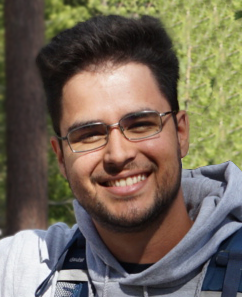
Pedro FigueiredoI'm a Senior Researcher at Huawei Canada, focusing on neural graphics and image/video generation for mobile devices. I received my Ph.D. from Texas A&M University, advised by Nima Kalantari. My research sits at the intersection of Physically Based Rendering and Generative AI. I specialize in developing fast, efficient neural light transport solutions, from high-level PyTorch prototyping and finetuning of large diffusion models to low-level C++/CUDA implementations that maximize hardware performance. During my Ph.D., I was a Graphics Research Intern at Intel, where I introduced an automatic data resampling strategy to improve consistency in video diffusion generation. Previously, I was a Research Intern at NVIDIA's DLSS team, exploring neural optical flow estimation and architecture optimization for frame interpolation. In 2021, I was a Machine Learning Intern at Ericsson, where I developed a resource forecaster and an internal semantic search engine for engineers. I graduated summa cum laude with a B.Sc. in Computer Science from Eötvös Loránd University, Hungary. I was previously a B.Sc. student in Computer Engineering at Universidade Federal da Paraíba, Brazil. Email / CV / GitHub / Google Scholar / LinkedIn |
|
Research |
|
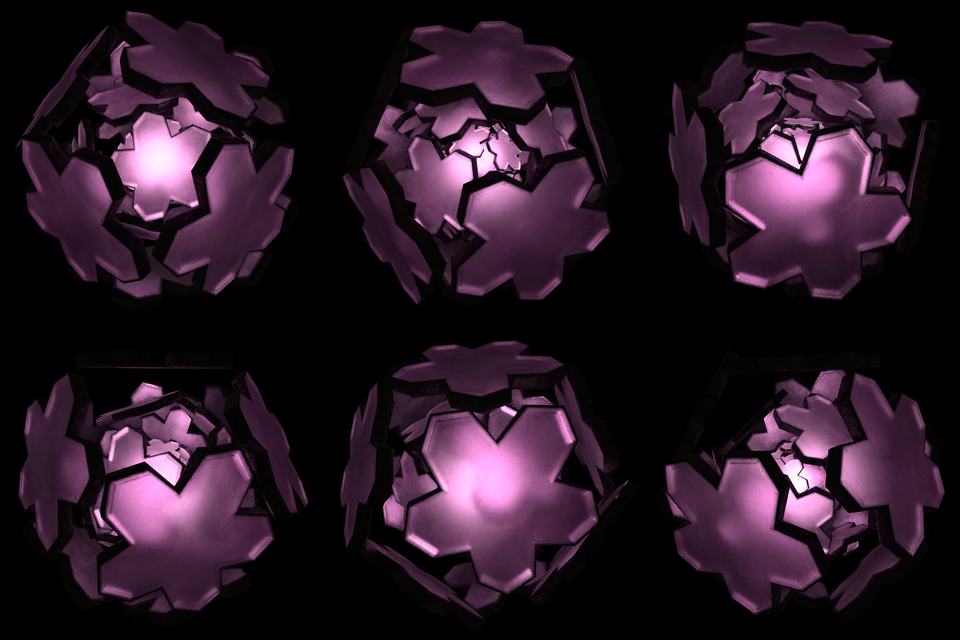
PureLight: Learning Complex Luminaires with Light TracingPedro Figueiredo, Zixuan Li, Beibei Wang, Miloš Hašan, Nima Khademi Kalantari SIGGRAPH Asia, 2026 paper / code / website / Learns the appearance of complex luminaires from light-traced samples using distribution learning and distills it into a lightweight neural representation. Enables low-noise rendering of challenging luminaires at low sample counts in arbitrary scenes. |
RealMat: Realistic Materials with Diffusion and Reinforcement LearningXilong Zhou, Pedro Figueiredo, Miloš Hašan, Valentine Deschaintre, Guerrero Paul, Yiwei Hu, Nima Khademi Kalantari Computer Graphics Forum (CGF), 2026 paper / code / website / Generates realistic SVBRDF materials using diffusion models and reinforcement learning. We leverage Stable Diffusion XL and a realism reward function trained on real images to bridge the gap between synthetic training data and real-world material appearance. |
|

|
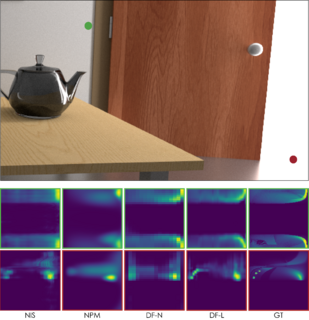
Neural Importance Sampling of Many LightsPedro Figueiredo, Qihao He, Steve Bako, Nima Khademi Kalantari SIGGRAPH, 2025 paper / code / website / Estimates spatially varying light selection distributions to improve importance sampling in Monte Carlo rendering. To efficiently manage hundreds or thousands of lights, we integrate our neural approach with light hierarchy techniques using a residual learning strategy. |
|
Neural Path Guiding with Distribution FactorizationPedro Figueiredo, Qihao He, Nima Khademi Kalantari Eurographics Symposium on Rendering (EGSR), 2025 paper / code / website / Introduces a fast and expressive neural path guiding method that breaks down the 2D distribution over the directional domain into two 1D probability distribution functions (PDF) modeled by tiny MLPs. Integrates radiance caching to reduce variance of optimization. |
Frame Interpolation for Dynamic Scenes with Implicit Flow EncodingPedro Figueiredo, Avinash Paliwal, Nima Khademi Kalantari Proceedings of the IEEE/CVF Winter Conference on Applications of Computer Vision (WACV), 2023 paper / code / website / Interpolates challenging near-duplicate photos leveraging bidirectional optical flows encoded via a hypernetwork. The proposed continuous representation generates superior intermediate frames particularly under challlenging illumination variations. |
|
|
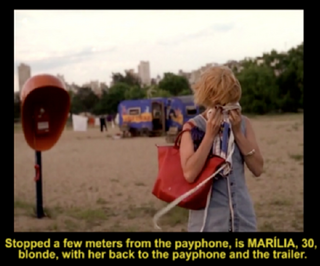
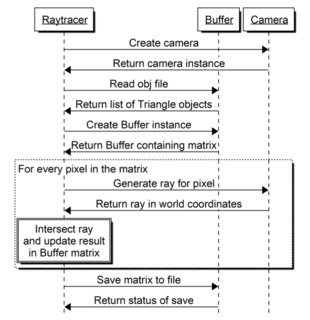
Machine Generation of Audio Description for Blind and Visually Impaired PeopleVirgínia P. Campos, Luiz M. G. Gonçalves, Wesnydy L. Ribeiro, Tiago M. U. Araújo, Thaís G. Do Rego, Pedro Figueiredo, Suanny F. S. Vieira, Thiago F. S. Costa, Caio C. Moraes, Alexandre C. S. Cruz, Felipe A. Araújo, Guido L. Souza Filho ACM Transactions on Accessible Computing, Volume 16, Issue 2, 2023 paper / Introduces an enhanced automatic audio description system that leverages both movie scripts and video visual cues to deliver succinct, synchronized descriptions for blind and visually impaired users. |
|
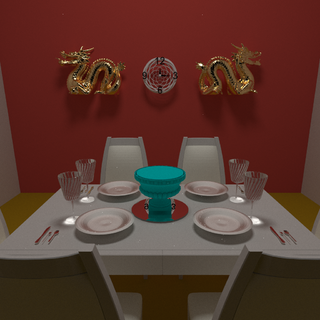
How to Increase Interest in Studying Functional Programming via Interdisciplinary ApplicationPedro Figueiredo, Yuri Kim, Nghia Le Minh, Evan Sitt, Xue Ying, Viktória Zsók Proceedings Eighth and Ninth International Workshop on Trends in Functional Programming in Education, 2020 paper / website / Explores the use of a ray tracer application to enhance student engagement in functional programming through a teaching experience with positive outcomes. |
|
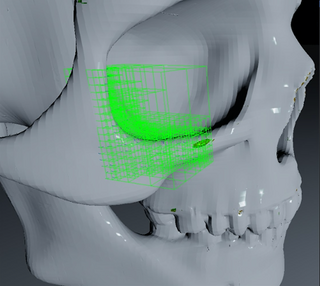
Generating Adaptive Distance Fields from Triangle MeshesPedro Figueiredo, Csaba Balint, Robert Ban 7th International Conference on Mathematics and Informatics, 2019 abstract / presentation / Proposes an efficient bidirectional conversion of triangle meshes to signed distance fields using a fast octree-based discretization, which enables advanced operations like offsetting and morphological transformations. |
|
Relato de Experiência Sobre o Aprendizado de Introdução à Renderização Baseada em Física em um Curso de Graduação da Área de ComputaçãoPedro Figueiredo Comunicações em Informática, 2017 paper / website / Reports on a Physically-Based Rendering course experience in a computer science program, emphasizing its role in boosting student motivation, reducing dropout rates, comparing its content with other courses, and offering suggestions for future iterations. |
Experience |

|
Senior ResearcherHuawei Canada 08/2026 - Present | Vancouver, BC, Canada Working on neural graphics and image/video generation for mobile devices. |

|
Graphics Research InternIntel 09/2025 - 01/2026 | Santa Clara, CA, United States of America Finetuned pre-trained image diffusion models to enable the next generation of real-time generative gaming on mobile GPUs. Introduced automatic data resampling to improve scene-wide conditioning, driving more consistent video generation. Engineered multi-node distributed training to accelerate iteration speed while adhering to a strict inference VRAM budget. |

|
Research InternNVIDIA 05/2023 - 08/2023 | Santa Clara, CA, United States of America Researched frame interpolation algorithms for DLSS, exploring neural optical flow estimation toward multi-frame generation. Designed architecture improvements to mitigate ghosting artifacts from disocclusions and to optimize rendering speed. |

|
Machine Learning InternEricsson 05/2021 - 08/2021 | Plano, TX, United States of America Built a containerized deep-learning resource forecasting pipeline to optimize infrastructure allocation. Developed an internal semantic search engine to accelerate documentation discovery for engineering teams. |

|
Researcher in Computer GraphicsEötvös Loránd University 08/2018 - 12/2019 | Budapest, Hungary Created OpenGL application using octrees to leverage signed distance functions as a way of performing fast affine transformations in 3D meshes. Novel mesh representation allows real-time computation of operations not feasible in real-time before. Research on signed distance functions and real-time cone tracing. |
|
|
Software Developer InternEricsson 05/2018 - 12/2019 | Budapest, Hungary Developed prototypes for Ericsson’s edge computing platform leveraging quick response times from 5G hardware. Engineered and deployed 5G IoT applications for cloud computing hosted on AWS and Microsoft Azure. Research on containerization applied to 5G IoT applications. |
|
C++ Developer InternLAVID/UFPB 01/2016 - 12/2017 | João Pessoa, Brazil Developed and optimized of software for image and video processing. Implemented application that leveraged object recognition via CNNs and text-to-speech tools for the visually impaired. |
Teaching |
ResearcherNSF RET in Engineering and Computer Science at Texas A&M University 06/2024 - 06/2024 | College Station, TX, United States of America website / Taught rendering concepts to a public school teacher via interactive ray tracing assignments on WebGL to inspire graphics-related classroom activities in the following school year. |
|

|
Graduate Teaching AssistantTexas A&M University 01/2021 - 05/2023 | College Station, TX, United States of America Lectured and developed assignments for practical classes of CSCE 121 Introduction to Program Design & Concepts (C++) - Spring 2021; and CSCE 221 Data Structures and Algorithms Spring 2022. Developed main project deliverable and performed grading for CSCE 310 Database Systems - Summer 2022. Hosted office hours and performed grading for CSCE 441 Computer Graphics - Fall 2021, Fall 2022; and CSCE 448 Computational Photography - Spring 2023. |
|
|
Lecturer and Researcher in Functional ProgrammingEötvös Loránd University 01/2019 - 12/2019 | Budapest, Hungary Lectured practical functional programming undergraduate classes for Spring and Fall 2019. Research focused on ray tracing application on functional programming for motivating functional programming students. |
Other Projects |

|
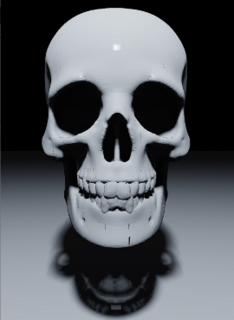
Compact Neural Representations for Efficient Light Transport SimulationPh.D. Thesis 06/2026 paper / presentation / Dissertation submitted to Texas A&M University in partial fulfillment of the requirements for the degree of Doctor of Philosophy in Computer Science. |
|
Octree-based Approach for Real-time Visualization of Surfaces Defined by Signed Distance FieldsB.Sc. thesis 01/2020 paper / presentation / Estimates surfaces of arbitrary watertight triangle meshes by approximating signed distance functions (SDFs). We use an efficient octree to approximate distance values of nearby triangles. Allows real-time visualization of operations best defined in the implicit SDF representation such as the offset, union, and intersection. |
|
|
Logon RendererPersonal Project 06/2017 website / code / Logon Renderer is a project started on the Physically Based Rendering course, offered by Christian Pagot, at Universidade Federal da Paraíba. The application is a physically based path tracer written from scratch in C++ for educational purposes. |
Awards |
|
|
Research and Presentation Travel AwardTexas A&M University 06/2025 | College Station, TX, United States of America |
|
|
Research and Presentation Travel AwardTexas A&M University 01/2023 | College Station, TX, United States of America |
|
|
Outstanding Bachelor's Thesis AwardEötvös Loránd University 01/2020 | Budapest, Hungary |
|
|
First Place Award on the Scientific Students' Associations (TDK)Eötvös Loránd University 11/2019 | Budapest, Hungary |

|
Hungarian National Higher Education ScholarshipGovernment of Hungary 09/2019 | Budapest, Hungary |
|
|
Stipendium Hungaricum Scholarship (Full Tuition)Eötvös Loránd University 02/2018 | Budapest, Hungary |
|
Design and source code from Jon Barron's website |